
Reframe Seemingly Negative Situations as Positive
Happiness Manual - Chapter 7: Everything is neutral - our judgement depends on our perspective. Perspectives can be changed.

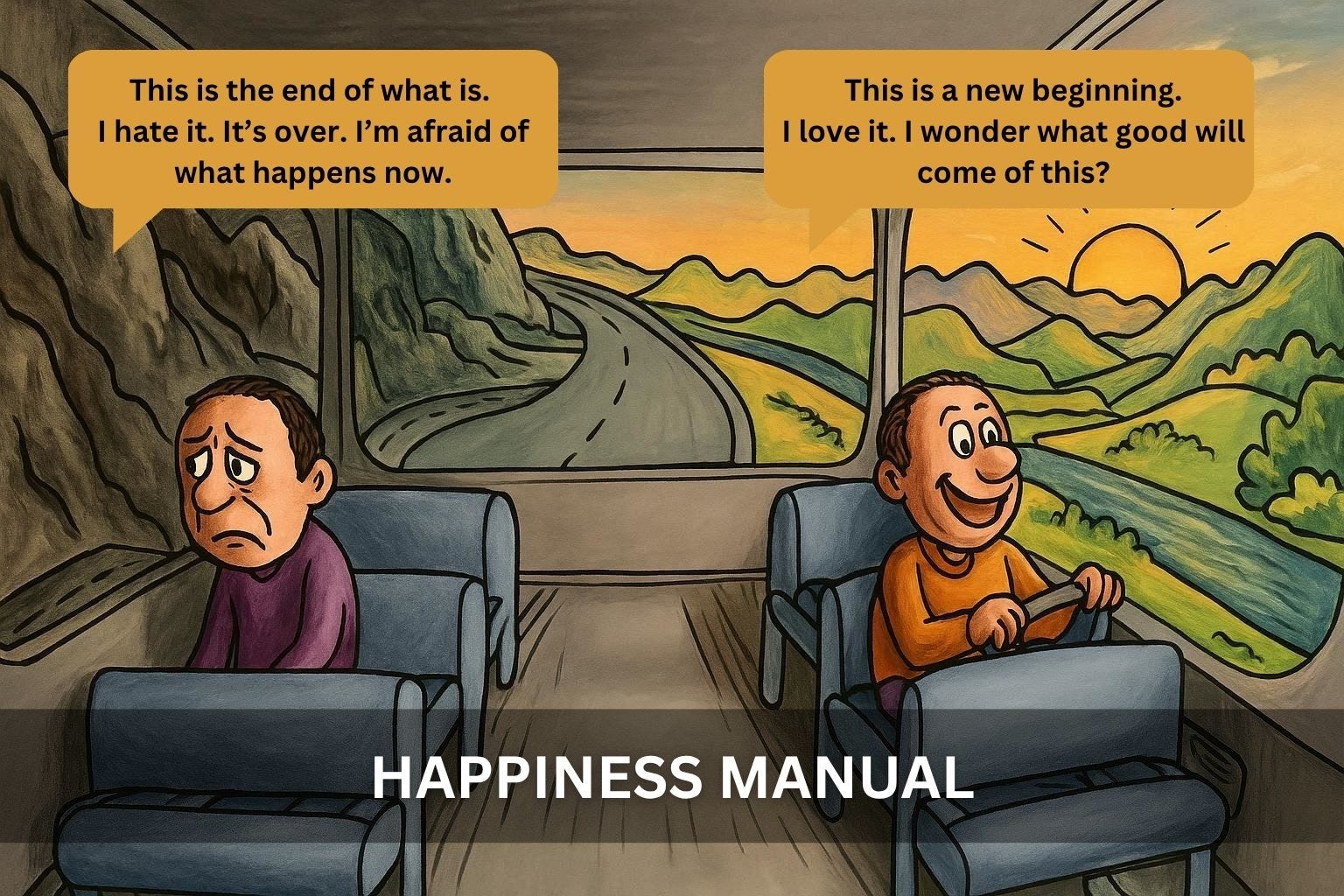
This is chapter 7 of a 13-part Happiness Manual. Subscribe, as there is more to come!
Everything is a perspective; there are no objective truths
Things, in general, are objective, senseless, pointless, and meaningless. We are the ones who give them meaning.
That meaning, and their sense of goodness or badness, will depend on many things, starting with our perspective.

Who determines what is evil? Who decides what is good?
Is there a universally time-proof, all-culture-acceptable rulebook for what is good, bad, just, evil, acceptable, and desired? No. It’s all based on the perspective, culture, and history of the one doing the judging.
In each conflict, what is good for one side is bad for the other. The same is true for competition.
We like to refer to nature for a sense of fairness and distinctions between good and evil. Are you sure? Because the nature I know is cruel, completely unbiased, and has zero sympathy.
How about religion? Dear god, let’s not use religious texts to define morality and ethics!
What about a more mundane example?
We failed at something, or something bad happened to us. Our plans were thwarted, and at the time, it seemed as if our world was falling apart. But has it?
Is it not true that, looking back, there are so many things and events we believed were bad back then that turned out to be the right, good, maybe even best thing to happen to us?
Had you not broken up with that lover, you would never have met this one or started a family.
Had you not been fired from your work, you would probably never have pursued your passion and made it big.
Had you not gotten sick in the past, you would perhaps be dead by now, because you changed your lifestyle.
It is the same situation, separated only by time, and the meaning around it has changed dramatically.
Why can’t you be grateful for the adverse situation right now, since you know you’re going to be, one day, when it is but a memory of a distant past?
If it’s not objective, we can change the meaning
Look at each problematic or traumatic situation in your life — past, present, or future — and find a way to reframe it.
Look for the possible good in that situation. Try to detach your emotions, beliefs, and energy from any situation. Make it neutral, and then decide what kind of meaning you want to give it.
Ask yourself
Is it objectively true (how I see things)?
Is there another way to look, explain, or see the same situation? What is it?
Can I find something positive about this person, event, thing, or situation?
Is it possible that this “thing” could end up being good in the end?
Why reframe the negative situations and memories?
Happiness is born of focusing on the good in our lives and the world, accepting the bad, and deciding to be happy, despite less-than-perfect conditions. It is a decision we make every day, until it becomes second nature.
Nothing is always perfect, but we can decide it is good enough. We can even call everything perfect and good, just as it is. It’s a matter of altering perspectives. There’s no truth there, other than “things just happen for no reason”.
Naturally, there are situations, such as the loss of a loved one or a terminal disease, where putting a positive spin on the situation will be difficult though not impossible.
There are three important reasons for reframing things
It’s impossible to be happy if we deem our situation as horrible, hopeless, or the end of the world. Since we’ve decided to be happy no matter what, reframing objectively neutral situations as somehow positive will help us maintain a good attitude, feel better, and be happier within the same situation.
There are events from our past that haunt us until the day we die. But they are just memories, and incredibly flawed in terms of accuracy and full of misunderstood conclusions. By reframing the past, we give it a positive spin, and that has long-reaching effects on our present and future.
In this weird universe of ours, the meaning we give things, people, and events tends to influence not only how we perceive them but also how they turn out. In a way, we are always right. When we decide something is good or will turn out good, we focus our attention on the good, so more good things, people, and situations will show up in our lives. You can call it a mental filter, seeing more good, or a manifestation, but the result is the same.
The past can only hold power over you if you let it
Let the past go. Find a way. Only then will you be free. Don’t drag things from your past into the future. You don’t have to. Sometimes, we are mentally and emotionally stuck on an adverse event and completely forget the good of the situation.
That is perfectly logical, as emotionally intense situations have the greatest impact on us. Even if 99% of a person or situation is good and pleasant, a negative 1% can completely distort how we perceive it.
Invest the time in remembering the good in a troublesome situation, past or present, and successfully reframe it as generally good. You will forever see that situation in a completely different light.
You will have “unburdened” yourself
Let’s say you’re angry at a boss from your previous job. He did you wrong. Before that, he believed in you, hired you, taught you a ton of new things, and provided you with a salary. He is both the “good and the bad guy”.
Maybe you feel your parents didn’t hear you, respect or love you. As a child, you’ve misunderstood a situation that was most likely just random nonsense that slipped your parents’ lips, as something that now defines you. If you are a parent yourself, you will see how quickly something like that can happen, and how children may react.
Realizing that truth, and reframing it as having nothing to do with you, as it was irrelevant or had more to do with your parents (not you), you can free yourself from the burden of that memory (trauma).
Exercise for the week ahead
Identify past, present, or future situations or events that have a strong emotional impact on how you feel. (fear, anxiety, depression, unhappiness, self-worth, resentment, jealousy…)
If you fear an AI apocalypse, for example, reframe the future as somehow positive. Humans have always been the problem. Why assume an AI would be worse, not better?
Reframe it: AI will not be the end of humanity, but may become the light that saves us from ourselves.
Perhaps you have a story of how you lost a lot of money on that investment. You are an idiot. You’ll never make up for those losses.
Reframe it as a lesson that you learned, which has just saved you millions in the coming years. You’ve paid a tuition, it wasn’t a mistake, but a lesson you needed to learn.
Maybe you lost your job or broke up with someone. Instead of thinking how that is the “end”, reframe it as an opportunity for something or someone better to come along.
You are now free, and the next opportunity will be much better.
Reframe a problematic situation or event so you can feel its effect, losing its power over you. Tell a different story, one where this situation or event is actually good, or at the very least, neutral.
Look at your current life and realize that it could have been much, much worse. Sure, some things aren’t perfect, but as a whole, you could be in a much worse position right now.
You’ve reframed something neutral, leaning on negative, into a positive situation. As a result, you will be happier. It’s not rocket science.
Coming soon
Chapter 8 of the Happiness Manual - Forgive everyone everything, but most importantly, forgive yourself. See you soon!