
Stop Running - Face Your Demons Head-On
Happiness Manual - Chapter 9: We all have our demons (issues). Find a way to resolve them. I have suggestions.

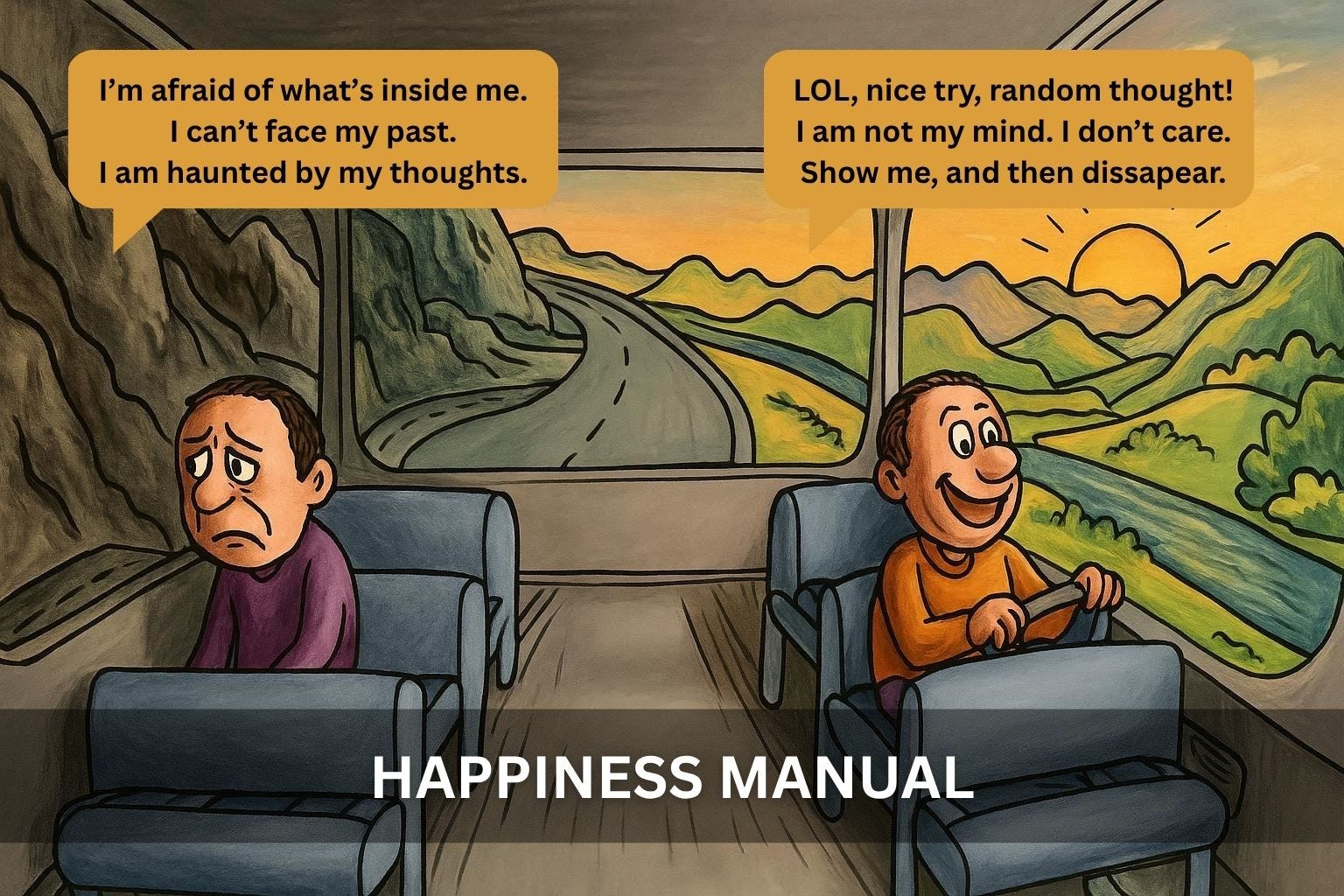
This is chapter 9 of a 13-part Happiness Manual. Subscribe, as there is more to come!
The freedom lies in understanding the issue for what it is - nothing but a corrupt memory “file” you accepted as truth about you, because you stored it during an emotionally charged situation, and didn’t know better. But it is, in fact, complete bullshit! It has nothing to do with you now. If you forgot the memory, you would instantly be free.
Hello, demon hunter
It’s hard to be happy, no matter where you are, if your inner voice is abusing you non-stop!
It’s also difficult to move to a better circumstance if you keep self-sabotaging yourself for some silly reason.
Running away, pretending they don’t exist, doesn’t work
We all have our demons (issues). They haunt us day and night. Don’t run and hide from them. Take the time to identify your issues and decide you’ve had enough. Find a way to resolve them.
Yes, it’s uncomfortable. No, none of us wants to do it. Yes, it takes time, and yes, it looks hopeless. The thing is - we don’t really have a choice. If we want to be in a better mind space, we need to deal with our garbage.
The idea is simple
As long as you run away from your issues, they run after you, gaining power every day.
As soon as you gather the courage to face them, you take their power away from them, and they dissolve into nothingness.
These demons are all bark and no bite
When we talk about our inner issues, we are talking about psychological traumas that have nested in our consciousness and are now part of who we believe we are.
Most of us subconsciously believe that opening ourselves up to them, facing them, allowing ourselves to feel them fully, will somehow fuck us up irreparably.
Fortunately, the opposite is true. They have their greatest power over us while we are afraid of them. Once we face them, we realize there was nothing to fear in the first place.
What exactly do you think will happen if you allow yourself to deal with them?
Write it down, whatever it is: “I’m going to go mad. I can’t handle the pain. I will be consumed by it. I won’t like what I find. I will make it worse somehow.” Then check:
Is that true?
What are the odds of that happening?
I prefer to process things in private, with a pen and paper, but you may not. I’ve also never met your demons or seen how you react to your issues when they flare up.
If you believe you may hurt yourself or someone else while you process these issues, please do so in the company of a trained professional, or at least a friend, who will ground you in reality.
What are those demons (issues)?
Are they actual entities? No.
Are they outside forces that have power over us? No.
Are they some sort of secret identity we hide from the world? Maybe.
Are they a kind of mind virus that will infect our minds? If they are, you’re already infected.
All your inner demons are nothing more than:
Bad memories. They’re not real.
They’re just images, sounds, and emotions we sometimes replay in our minds. Like a movie influencing your five senses, because you forget you’re watching a movie.
They can’t hurt us unless we react to them; therefore, we hurt ourselves.
You can initiate a memory, and you can always stop a memory. You’re the boss.
Thoughts accompanied by feelings. There’s nothing solid there.
Who controls your thoughts? You do, and subsequently, you control your emotions!
These thoughts sometimes come up by themselves, but you never lose control of your mind. You just think you do, because you don’t detach and stop them.
Once you learn that you have that power - to just step back within your mind, and say “No!” to your thoughts, without caring about the substance of their raging, you will now have true freedom, accompanied by peace.
A part of our mind, our identity, which is nothing more than a story we constantly tell ourselves.
But are you the same person as, for example, a five-year-old kid who heard his parents say something mean, and now believes that is who he must be? (not good enough, a loser, unlovable, weak, stupid…)
Who are you without those memories?
Who are you without those thoughts and emotions?
Who are you without that story?
How could a story hurt us?
Why would we let it define us?
Since it’s just a story we accepted as “us,” who says we can’t change that story? Write a new script.
Whatever issue you have isn’t some solid structure
It is not a fact. It is not you! It’s a mental image, and a form of stored energy in your body. The only power it holds over you is the intensity of your belief in it and your unwillingness to face it.
The freedom lies in understanding the issue for what it is - nothing but a corrupt memory “file” you accepted as truth about you, because you stored it during an emotionally charged situation, and didn’t know better. But it is, in fact, complete bullshit!
What does it take to overwrite it?
Well, equally strong, emotionally charged mental experiences will do the job just fine. Hopefully, even that won’t be necessary.
Just shining the light of your awareness on the issue, allowing it to play out, might be enough.
We are all different. Find what works for you. I offer plenty of options to start in this article.
Identify your issues, let them express themselves, and let them go
Think about an issue (feeling, memory, or belief). Give it a name. Try to remember how it began, find the origin story.
Usually, they go back to our childhood, but it could be more recent. Write it all out. Feel what this situation brings up, don’t run away from those emotions. You can’t outrun them—the only way is through.
Ask yourself:
Where did I first encounter this issue, these feelings, and these beliefs?
What are you (the feeling) trying to tell me?
Then wait for the answers to come. They might come in the form of feelings, revelations, memories, words… Accept them, observe them without judgment, and then let them go. There’s no “thinking.”
None of this is truly logical. It’s emotional. It needs to be felt and released. That’s all there is to it, generally speaking. When accompanied by a stern realization of how silly they were, you’ve won.
Various methods of facing your demons
For some people, allowing feelings and thoughts to surface, observing them without judgment and with as little involvement of the mind as possible, is enough to resolve them permanently.
The process of observing your issue
Don’t overthink it: observe your body, your emotions, and sensations within as an objective observer (as if you were watching a movie).
Bring the topic to mind with as few words and details as possible, then direct your full attention to how it makes you feel.
Do nothing else. Observe. There is no rush. There is nothing to achieve. Don’t try to feel better, question why, or judge.
Simply observe and let those sensations play out fully. Allow yourself to feel whatever you feel. They won’t bite - I promise.
Do not identify with the thoughts, stories, and feelings. Observe them as a separate entity, a watcher. You can’t get hurt. You don’t have to engage them.
When you have found thoughts, ideas, and habits to which you have the strongest emotional reaction, stay with them.
Allow your subconscious awareness to deal with them (the “not-mind” which is all that is not your conscious mind).
Bring them to mind in a meditative state (eyes closed, calm, alone). Call them up by simply naming them. For example: “My job,” or “I hate my job.”
When you bring it to mind, you will feel the reaction within.
Ask yourself (your emotions): “What are you trying to tell me? Why do I feel this sensation? It’s okay, show me. I’m ready to listen.”
Then all you want to do is observe the feelings within. Nothing more.
You will notice a tiny miracle. The more you allow those feelings to express themselves as you observe them without judging them or trying to fix them, the less power (emotional charge) they have. The negative reaction in your body will begin to dissipate. For me, those sensations are usually nestled in my stomach or chest.
You are done with a sore subject when you no longer feel any negative sensation upon thinking about it, and all you had to do was observe it and let it express itself.
Visualization to rewrite the memories
You can rewrite those childhood memories, for example, by visualizing a different scene.
Create a new memory and loop it until it feels like the real thing. Guess what - now it is!
Memory is just a thought. It’s not a solid reality. You can replace them.
One could argue that you’ve changed the past, as the past is nothing more than a memory. Whatever hold you believed it held over you is now gone. It was never real, to begin with.
Autonomous methods
An interesting tool is the Sedona Method, in which you ask yourself a series of simple questions and continuously release troublesome feelings. What am I feeling? Could I let go (it’s just a feeling)? Would I? When?
When you don’t know what issue is plaguing you, you could try the popularized “Hoʻoponopono” practice combined with taping, for example. It’s an interesting way to express deeply submerged emotions without targeting a specific issue.
Just keep repeating: “I love you. I’m sorry. Please forgive me. Thank you. (Like you mean it!).”
I preferred to do it with my eyes closed and following the NLP tapping sequence. Fair warning: you’re probably going to cry for no reason, but maybe it’s not “for no reason,” if you know what I mean.
Self-analysis method
If you prefer a more rational, drawn-out analysis, the guide below will get you started. You can, of course, always pay for a therapist to help you. Just stop running.
Ask yourself:
Is this true?
Is that what really happened?
Did my parents (example) really mean what I heard?
Did anything they said or did really have anything to do with me, or was it just “them”?
Could I have misinterpreted that situation somehow? Is there an alternative explanation, a story?
Do I still want to carry this past situation with me? For how long? When is enough? Who decided that?
How does it benefit me to keep these thoughts and ideas?
If my child had the same reaction and carried the same feelings into the future after something I did as a parent, is that child right to blame themselves?
What exactly do the five-year-old version of you and the fifty-year-old version of you have in common?
Are they even the same person?
What does anything that happened to that child have to do with you now?
Exercise for the week ahead
Go demon hunting using the methods listed above.
Try multiple variations, and see how they feel.
Do not give up until you feel no emotional reaction anymore. Don’t force it either. A gentle but persistent approach is best here.
Good luck, demon hunter!
Coming soon
Chapter 10 of the Happiness Manual - Be picky with what you mentally consume. See you soon!